Thursday, June 16, 2011

Monsters Unleashed #7: "The Monster In the Mist!" (Al Williamson art)


Download Monsters Unleashed #7


Back in the old days, before the comics industry felt the need to censor its own product, EC Comics produced some of the finest science fiction comics ever published. One of the reasons why Weird Science, Weird Fantasy (and later, Weird Science-Fantasy) were so good was the work of a lanky young man named Al Williamson. At 21, Williamson was the youngest of the EC family, but everyone was in awe of his draftsmanship. Williamson could draw bravura science fiction adventure like no one else, though it didn't hurt that he had the likes of Frank Frazetta, Roy Krenkel, and Angelo Torres assisting him with backgrounds and inking.

After the collapse of the EC line of comics. Williamson worked for such companies as ACG, Atlas, and Harvey, to name just a few, bringing to the stories what he did for their SF and mystery titles the same superb rendering and palpable sense of atmosphere that made his EC work so memorable. In addition to the comic books he did, Williamson also made significant contributions to the art of the comic strip, ghosting several weeks of Flash Gordon for Dan Barry, and assisting John Prentice on Rip Kirby. These last two assignments are particularly ironic when you consider that it was Alex Raymond's Flash Gordon that inspired Williamson to become a comics artist in the first place. Indeed, Williamson had been the primary proponent of heroic realism in comics, and is the rightful heir to the Flash Gordon mantle of Alex Raymond, something Williamson proved with his superb work on the King Flash Gordon title of the mid '60s, and on the Flash Gordon movie album adapted from the (otherwise wretched) DeLaurentiiss film.


Credits

Cover painting: Richard Hescox
Script: Unknown
Pencils: Al Williamson
Inks: Ralph Mayo

Reprinted:
  • From ASTONISHING #60 (April 1957).
  • In Monsters Unleashed (Marvel, 1973 series) #7 (August 1974).


Sunday, June 5, 2011

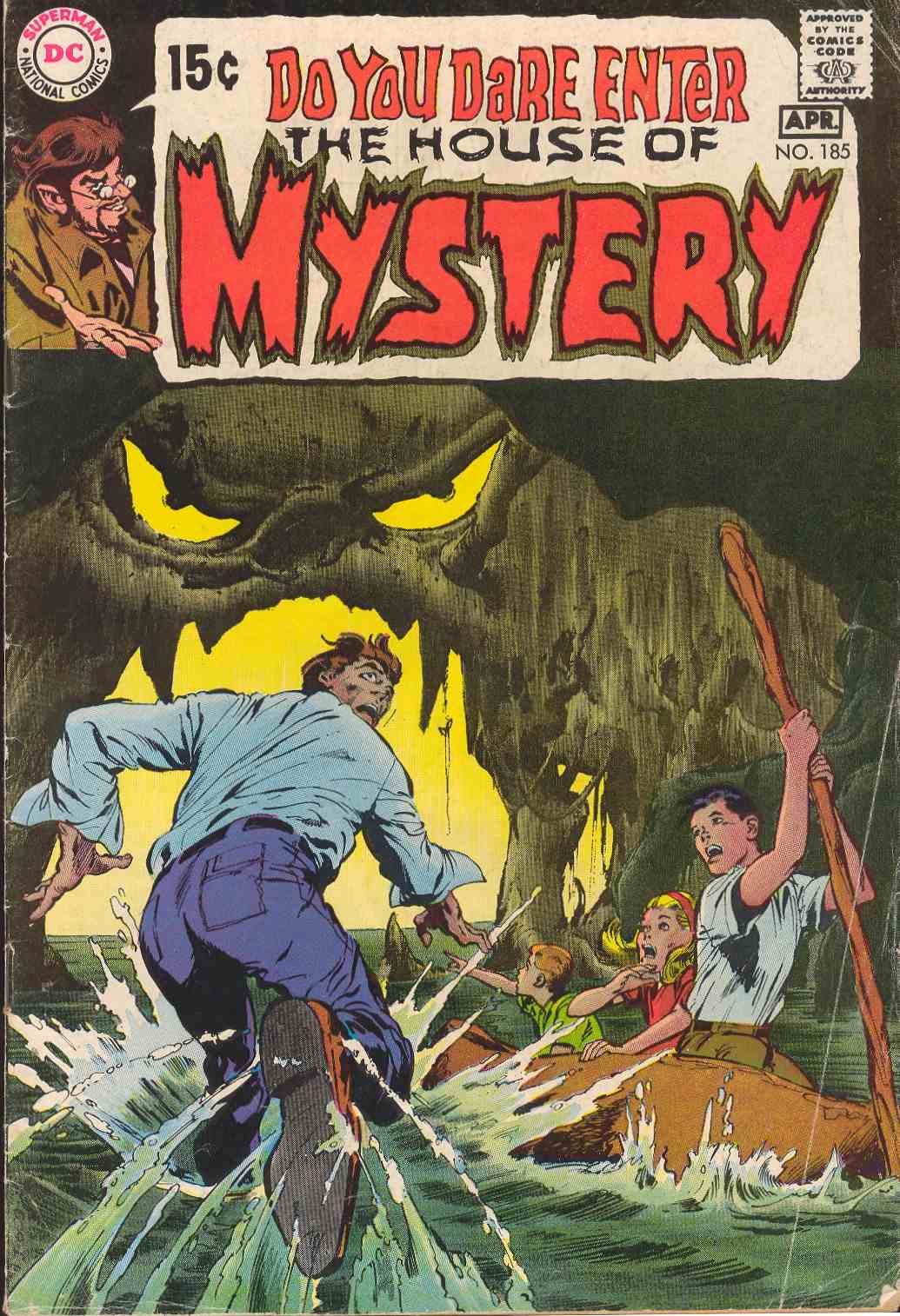
House of Mystery #185: "The Beautiful Beast" (Al Williamson art)


Download House of Mystery #185


House of Mystery started out as a horror anthology, featuring tales of the supernatural as well as supernatural-themed mystery stories. However, with the growing backlash against horror comics in the mid-1950s, as well as the advent of the Comics Code Authority and its restrictions on horror-themed storylines (banning stories dealing with such supernatural fare as werewolves, vampires, and such), the series quietly was revamped into dealing with science-fiction type monsters and other mystery-suspense type tales that were permitted by the comic code.

With issue #174, EC Comics veteran Joe Orlando was hired by DC to take over as editor of House of Mystery. As the Comics Code Authority was now being challenged by both DC and Marvel over content restrictions, the series returned to its overt horror themes. The first issue under Orlando would be a reprint issue of old horror/suspense stories, as the new direction would truly begin with #175 (July/August 1968). The issue would introduce a new figure to the series, Cain, the "able care taker" of the House of Mystery who would introduce nearly all stories that would run in the series before its cancellation.


Credits

Cover: Neal Adams
Script: Joe Gill
Pencils: Al Williamson
Inks: Al Williamson

Reprinted:
  • in Showcase Presents: The House of Mystery (DC, 2006 series) #1.


Thursday, April 28, 2011

Eerie #13: "The Success Story" (Al Williamson art)


Download Eerie #013


Of particular fame (or is it infamy?) in Warren Publishing lore is Creepy #1's "The Success Story," written by Archie Goodwin and expertly drawn by Al Williamson, which legend has it was based on a real-life comic strip artist, Don Sherwood, who, according to George Evans and others, over-relied on "ghost" artists—behind-the-scenes creative contributors who received no credit. The tale, a scathing critique of that all-too-common practice in cartooning of signing one's name to another's work, was allegedly about Sherwood (cast here in the guise of smug comic-strip artist "Baldo Smudge") and his daily strip, "Dan Flagg." Williamson, renowned for using photographic reference, looks to have used the likenesses of Archie Goodwin, and artists Angelo Torres and Alden McWilliams, with Al himself serving as model for Smudge. (It should come as no surprise that all of these creators, also Warren contributors, worked uncredited on "Dan Flagg." Ahh, sweet revenge...!

Note: Eerie #13 reprints this story as it originally appeared in Creepy #1.


Credits

Cover painting: Vic Prezio
Script: Archie Goodwin
Pencils: Al Williamson
Inks: Al Williamson
Letters: Ben Oda

Reprinted:
  • from Creepy (Warren, 1964 series) #1 (January 1965)
  • in Eerie (Warren, 1966 series) #13 (February 1968)
  • in Comix: A History of Comic Books in America (Bonanza, 1971 series) #[nn]
  • in Comix: A History of Comic Books in America (Outerbridge & Dienstfrey, 1971 series) #[nn]
  • in Eerie (Gold Star Publications, 1972 series) #4 (1973)
  • in Creepy (Warren, 1964 series) #137 (May 1982)
  • in Creepy The Classic Years (Harris Comics, 1991 series) #[nn]
  • in Creepy Archives (Dark Horse, 2008 series) #1


Wednesday, April 20, 2011

Eerie #5: "The Jungle" (Al Williamson art)


Download Eerie #5


During Eerie's "dark period," many of the artists drew, perhaps without the sophistication of an Al Williamson, but with a lovely eye for the ugly and mundane. Perhaps it's a lack of experience rather than deliberate artistic choice, but it means that many of the later stories read like a surprisingly fun movie shot by a disturbed amateur.


Credits

Cover painting: Frank Frazetta
Script: Archie Goodwin
Pencils: Al Williamson
Inks: Al Williamson
Letters:Ben Oda

Reprinted:
  • in Eerie (Warren, 1966 series) #18 (November 1966.


Friday, April 15, 2011

Eerie #3: "The Lighthouse!" (Al Williamson art)


Download Eerie #3


Comic book fans, and specifically EC fanatics, must have lost their minds when the first issues of Creepy and Eerie appeared on the newsstands. Not only were they the first real attempts to do an EC-like horror anthology in ages, their pedigrees were simply beyond dispute. Warren hired the best of the best, the most talented comics artists (many of whom had worked for EC before its unfortunate end) and the most brilliant of writers.

One writer in particular set the tone for the magazine: the late, lamented Archie Goodwin. Archie is still spoken of with the quiet tones one uses when speaking of saints, but beyond being an extraordinary editor, he had this format down cold. In those first issues, we see again and again how he manages to give a literary quality to even the most galloping bit of shaggy-monster goings-on. He knew how to deliver the punch line to a story like few ever learn these days, with shotgun volume, but sniper-rifle accuracy. And above all, he had taste.

His artists rose to the occasion. You could see the incredible line work of Reed Crandall, the inimitable curves and shadows of Gene Colan, and a who's who of the best, most tasteful, and most accomplished artists the industry had to offer. Adams, Toth, Ditko, on and on... these people must have been delighted at the macabre delicacies offered in Creepy and Eerie. Breaking the censoring shackles of the Comics Code Authority must have been a bloody pleasure.

Then everything went to hell, somehow. The money dried up, Archie had to leave as editor, and the company was forced to rely, after issue #11, on lesser-known creative talents and reprints until regaining their funding and reputation in their salad days, a few years later.

I'm told this is called Warren's "dark period."

And I think it's apt, but not in the way most collectors mean. I don't find this period to be without merit. To the contrary, I think this is one of the most entertaining periods in the magazine's history.

Story after story by artists who either left comics or never really managed to get a proper toehold. Writers whose names I do not recognize. Lacking Archie Goodwin's experience and discernment, these people had to use the tools they had to tell their stories... a little grubbier, a little grittier, and a little... shall I say it?

A little eerier.


Credits

Cover painting: Frank Frazetta
Script: Archie Goodwin
Pencils: Al Williamson
Inks: Al Williamson
Letters: Ben Oda

Reprinted:
  • in Eerie Greatest Hits (Harris Comics, 1994 series) #[nn]
  • in Eerie (K. G. Murray, 1974 series) #5


Related Posts Plugin for WordPress, Blogger...