Showing posts with label Warren Publishing. Show all posts

Thursday, April 28, 2011

Eerie #13: "The Success Story" (Al Williamson art)


Download Eerie #013


Of particular fame (or is it infamy?) in Warren Publishing lore is Creepy #1's "The Success Story," written by Archie Goodwin and expertly drawn by Al Williamson, which legend has it was based on a real-life comic strip artist, Don Sherwood, who, according to George Evans and others, over-relied on "ghost" artists—behind-the-scenes creative contributors who received no credit. The tale, a scathing critique of that all-too-common practice in cartooning of signing one's name to another's work, was allegedly about Sherwood (cast here in the guise of smug comic-strip artist "Baldo Smudge") and his daily strip, "Dan Flagg." Williamson, renowned for using photographic reference, looks to have used the likenesses of Archie Goodwin, and artists Angelo Torres and Alden McWilliams, with Al himself serving as model for Smudge. (It should come as no surprise that all of these creators, also Warren contributors, worked uncredited on "Dan Flagg." Ahh, sweet revenge...!

Note: Eerie #13 reprints this story as it originally appeared in Creepy #1.


Credits

Cover painting: Vic Prezio
Script: Archie Goodwin
Pencils: Al Williamson
Inks: Al Williamson
Letters: Ben Oda

Reprinted:
  • from Creepy (Warren, 1964 series) #1 (January 1965)
  • in Eerie (Warren, 1966 series) #13 (February 1968)
  • in Comix: A History of Comic Books in America (Bonanza, 1971 series) #[nn]
  • in Comix: A History of Comic Books in America (Outerbridge & Dienstfrey, 1971 series) #[nn]
  • in Eerie (Gold Star Publications, 1972 series) #4 (1973)
  • in Creepy (Warren, 1964 series) #137 (May 1982)
  • in Creepy The Classic Years (Harris Comics, 1991 series) #[nn]
  • in Creepy Archives (Dark Horse, 2008 series) #1


Wednesday, April 20, 2011

Eerie #5: "The Jungle" (Al Williamson art)


Download Eerie #5


During Eerie's "dark period," many of the artists drew, perhaps without the sophistication of an Al Williamson, but with a lovely eye for the ugly and mundane. Perhaps it's a lack of experience rather than deliberate artistic choice, but it means that many of the later stories read like a surprisingly fun movie shot by a disturbed amateur.


Credits

Cover painting: Frank Frazetta
Script: Archie Goodwin
Pencils: Al Williamson
Inks: Al Williamson
Letters:Ben Oda

Reprinted:
  • in Eerie (Warren, 1966 series) #18 (November 1966.


Friday, April 15, 2011

Eerie #3: "The Lighthouse!" (Al Williamson art)


Download Eerie #3


Comic book fans, and specifically EC fanatics, must have lost their minds when the first issues of Creepy and Eerie appeared on the newsstands. Not only were they the first real attempts to do an EC-like horror anthology in ages, their pedigrees were simply beyond dispute. Warren hired the best of the best, the most talented comics artists (many of whom had worked for EC before its unfortunate end) and the most brilliant of writers.

One writer in particular set the tone for the magazine: the late, lamented Archie Goodwin. Archie is still spoken of with the quiet tones one uses when speaking of saints, but beyond being an extraordinary editor, he had this format down cold. In those first issues, we see again and again how he manages to give a literary quality to even the most galloping bit of shaggy-monster goings-on. He knew how to deliver the punch line to a story like few ever learn these days, with shotgun volume, but sniper-rifle accuracy. And above all, he had taste.

His artists rose to the occasion. You could see the incredible line work of Reed Crandall, the inimitable curves and shadows of Gene Colan, and a who's who of the best, most tasteful, and most accomplished artists the industry had to offer. Adams, Toth, Ditko, on and on... these people must have been delighted at the macabre delicacies offered in Creepy and Eerie. Breaking the censoring shackles of the Comics Code Authority must have been a bloody pleasure.

Then everything went to hell, somehow. The money dried up, Archie had to leave as editor, and the company was forced to rely, after issue #11, on lesser-known creative talents and reprints until regaining their funding and reputation in their salad days, a few years later.

I'm told this is called Warren's "dark period."

And I think it's apt, but not in the way most collectors mean. I don't find this period to be without merit. To the contrary, I think this is one of the most entertaining periods in the magazine's history.

Story after story by artists who either left comics or never really managed to get a proper toehold. Writers whose names I do not recognize. Lacking Archie Goodwin's experience and discernment, these people had to use the tools they had to tell their stories... a little grubbier, a little grittier, and a little... shall I say it?

A little eerier.


Credits

Cover painting: Frank Frazetta
Script: Archie Goodwin
Pencils: Al Williamson
Inks: Al Williamson
Letters: Ben Oda

Reprinted:
  • in Eerie Greatest Hits (Harris Comics, 1994 series) #[nn]
  • in Eerie (K. G. Murray, 1974 series) #5


Tuesday, February 15, 2011

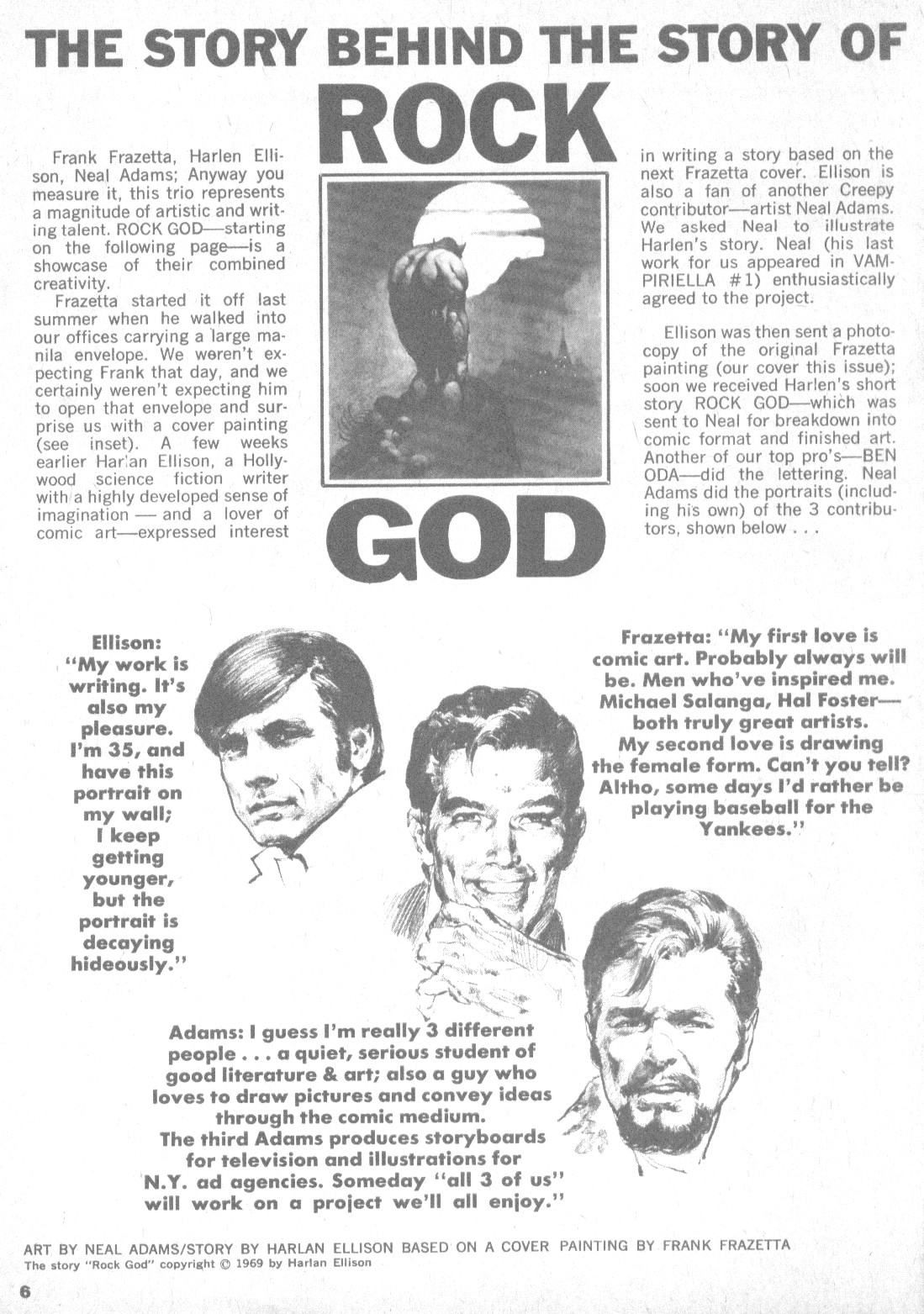
Creepy #32: "Rock God" (Frank Frazetta and Neal Adams)


Download Creepy #32


Another boy wonder, Frank Frazetta entered comics while in his teens. After working as an assistant to John Giunta, he joined the Bernard Baily shop in 1945. The next year he was appearing in such Ned Pine titles as Startling Comics and Thrilling Comics. He was doing mostly light stuff at this point, teenage characters, funny animals, and a hillbilly strip called Looie Lazybones. By the time he went to work for Vincent Sullivan's Magazine Enterprises in 1949, Frazetta had perfected his straight illustration style, which owed a good deal to his idol Hal Foster. For ME he drew Dan Brand in the Durango Kid and produced some striking covers for Ghost Rider. His most ambitious work for ME was the first issue of Thun'da. Next at DC Frazetta drew some episodes of Tomahawk and The Shining Knight. Over at Famous Funnies, he did a series of memorable covers featuring Buck Rogers and also drew some true stories for Heroic Comics. Frazetta did a few jobs for EC before taking on the newspaper racing-car strip Johnny Comet in the early 1950s. He also began a several-year run ghosting Li'l Abner for Al Capp, who was later outraged that many fans could tell Frazetta's work from his.

By the 1960s he had pretty much left comic books, except for the black-and-white Creepy. He painted covers for Vampirella and for the Ace reprints of the Conan novels. He went on to become a highly successful and much collected painter and illustrator and even set up his own museum.

Cover: Frank Frazetta
Script: (Redacted) (based on the Frazetta cover painting).
Pencils and inks: Neal Adams.

Note: "Rock God" won the 1970 Best Illustrated Story Award. Cover story.

Reprinted:
  • in Harlan Ellison's Dream Corridor Quarterly (Dark Horse, 1996 series) #1.


Sunday, February 13, 2011

Vampirella #19: "The Soft, Sweet Lips of Hell!"


Download Vampirella #19


The Bettie Page of the vampire world, Vampirella was introduced by Warren Publishing in 1969. The Vampirella magazine, like Warren's Creepy and Eerie, was black-and-white, aimed at a somewhat older audience, and sold for fifty cents. A Frank Frazetta color cover introduced Vampi to readers, showing her in her terse crimson costume, posing with one spike-heeled foot resting on a human skull. Sci-fi maven Forrest J. Ackerman, who was editing Famous Monsters for Warren, came up with the name, and in the early issues Vampi was played for laughs. When Tom Sutton became the artist with the eighth issue things got serious. Scripts by Archie Goodwin helped convert Vampirella into a viable vampire. A typical good/bad girl, she sometimes gave in to the urge to sink her teeth into somebody's throat, but she also built a career as a sexy ghostbuster, aided by her mentor Pendragon. Vampi usually appeared in the opening story with the rest of the issue given over to assorted horror tales. The magazine ended in 1983.

Since then the virtuous vampire has been brought back to life several times and is now published by Dynamite Entertainment.


Credits

Script: Denny O'Neil
Pencils and inks: Neal Adams, Steve Englehart


Related Posts Plugin for WordPress, Blogger...